Repair or just a cleaning? Read the pipe before you decide
What the camera finds and what usually follows
| Camera finding | What it means | Typical path |
|---|---|---|
| Grease or soft debris only | The pipe is sound but dirty | Cleaning or hydro jetting, no repair |
| Roots entering one joint | Pipe is cracked or loose at one spot | Spot repair at that joint |
| Belly or sag holding water | Soil beneath the pipe has settled | Section replacement or relining for minor sag |
| Long cracked or rough section | Pipe is failing along its length | Trenchless lining or replacement |
| Offset or separated joint | Pipe sections no longer align | Dig and replace the joint, or sleeve it |
| Collapse or missing section | The pipe has failed | Excavation and replacement |
We camera the line before quoting any repair. The video shows where the damage starts and ends, which pipe material you have and whether other defects hide behind the first one. You see the same footage we do, so the recommendation is something you can check.
Sewer repairs fall under the plumbing codes adopted locally, and many need a permit and an inspection before the trench is backfilled. Slope, bedding and approved pipe material are standards the inspector checks, so ask the City of Goose Creek building inspection division what applies to your repair.
Sewage backing up now, and the pipe may be broken
Most repair calls start as a backup. A line that fills again right after a cable clears it, a sewer smell in the yard, or a wet spot that appears with no rain are all signs the pipe is failing. We take these calls after hours and on weekends, and a plumber can be dispatched the same day when crews and equipment are free.
Before we arrive: limit the damage
- Stop water useEvery flush or load of laundry puts more wastewater into a broken line, and it can leak into the soil or back into the house.
- Mark any wet or sunken groundPut a flag or a cone near soft spots in the yard. They help us find the break and keep children and pets off weakened soil.
- Keep people and pets out of the areaRaw sewage in the yard or on a floor is a health hazard, so wash hands well after any contact.
- Do not dig it up yourselfBuried gas, water, power and communication lines are often close to the sewer. Call before digging and let a professional locate lines first.
- Note when it startedTell us when the smell, wet spot or backup began, and what changed, such as heavy rain, new landscaping or work nearby.
Root intrusion and the spot repair
Roots do not break a good pipe. They find a crack or a loose joint, grow into it and thicken until they hold back paper and grease. Cutting the roots gives relief for a few months, but the opening is still there.
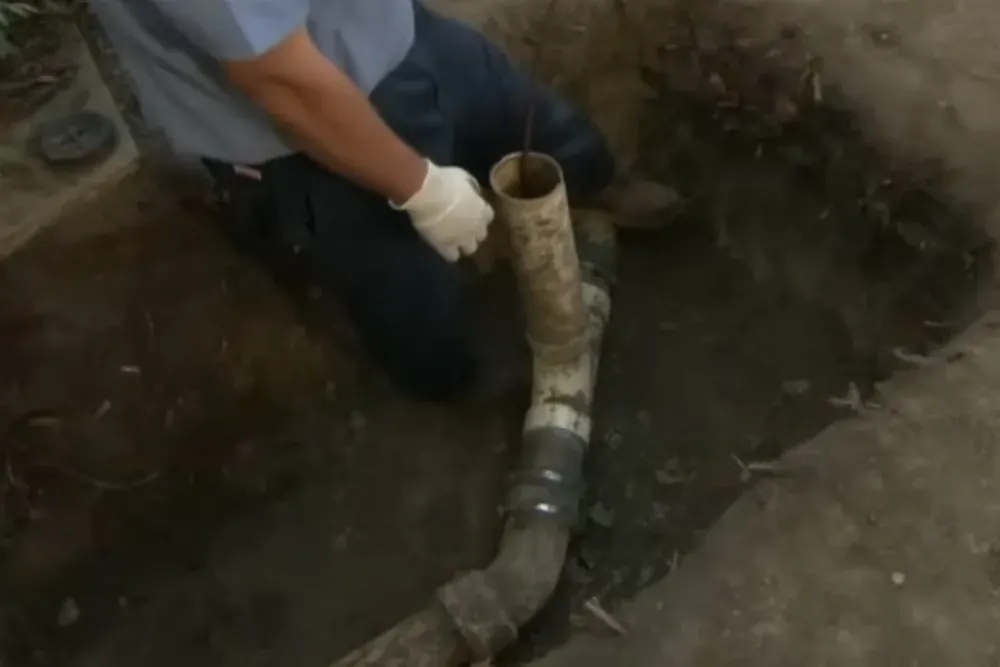
A spot repair fixes that single failure. If the camera shows damage in one place, usually a joint or a short cracked section, we locate it from above, open a small excavation and replace that length or sleeve it. The rest of the pipe stays in service.
This is the sensible answer for many Goose Creek lots, where cracked or cracking PVC and clay sections meet mature trees. Hurricane Hugo in 1989 broke trees across the city, and the ones that stayed are now larger, with roots that reach farther each year. That means roots near an older lateral deserve a camera look, not just a cable.
Trenchless repair and pipe lining
Trenchless methods repair a pipe without digging up its entire length. In lining, a resin-soaked tube is pulled or inflated into the old pipe and cured, forming a new pipe within the old one. It suits pipes that are cracked or rough but still aligned and open enough to receive the liner.
It does not suit every pipe. A collapsed section, a severe offset or a deep belly may need excavation, and a liner cannot fix a pipe that is missing. Lining also reduces the inner diameter slightly, which is rarely a problem for a four-inch house line but is something the camera should confirm.
The big advantage is the yard. Driveways, sidewalks, mature plantings and finished floors stay in place. For a line running under a slab or a driveway, trenchless options may be the only sensible way to avoid tearing out concrete.
Is trenchless an option for your line?
- The pipe is cracked, not collapsedLiners need an open pipe to travel through.
- The route is under hard surfacesA driveway, patio or slab makes digging costly and disruptive.
- Damage is spread over a long runLining covers a full section instead of repairing one spot.
- The pipe is cleaned firstDebris must be removed, often by hydro jetting, so the liner sticks.
- Fittings and connections are soundLiners handle straight runs better than complex junctions.
- Local permit rules allow itCheck with the building inspection division before choosing a method, since what is allowed can differ by address.
Cast iron pipe repair in older homes
Cast iron was common in drain and sewer lines of older houses. It lasts for decades, then rusts from the inside out, scaling and thinning until it cracks or leaks at joints. Signs include rough scaling seen on camera, a sewer smell near the foundation and repeated slow drains that cabling only briefly relieves.
Goose Creek grew quickly in the 1970s, so homes from that era may have cast iron under the slab or in the walls. Repair choices depend on where the iron runs. A short exposed section can be cut out and replaced with PVC using no-hub couplings, while a long run under the slab may be rerouted or lined.
Cast iron deserves caution with jetting and heavy cabling, because thinned walls can break. We camera first, look at the scale and decide on a gentle cleaning or none at all. If the iron is in poor shape, a repiping plan for the drain side may be cheaper than repeated spot fixes.
Buyers, sellers and the lateral replacement question
Buyers under contract often arrive with an inspector's note about a questionable sewer line. A camera report tells you whether the pipe needs repair now or just monitoring, and it gives you facts for a repair credit or a price adjustment. A sewer camera inspection is the first step and costs far less than guessing.
Full lateral replacement, from the house to the property line or the connection, is the answer when the pipe fails along its length or the grade is wrong. Which sewer provider owns the section matters, so confirm the property line and the connection point on your bill or with the provider before work starts.
P-trap dry, sewer smell upstairs
A trap that will not hold water and a sewer smell upstairs can come from a broken vent, a leaking drain joint, or a trap that evaporated in a little-used bathroom. Run the water and see if the smell fades. If it returns, a camera or smoke test can trace the path. Older homes across the line in Hanahan raise the same question.
What drives the cost of sewer line repair
- MethodA spot repair, a liner and a full dig-and-replace differ widely in labor, materials and equipment.
- Depth and length of damageA short break near the surface is a smaller job than a long run buried deep.
- What sits on topLandscaping, a driveway, a slab or a patio add restoration work to the bill.
- Pipe material and conditionCast iron, clay and PVC call for different parts and techniques.
- Permit and inspectionA dig or a pipe replacement may bring a permit and an inspection into the schedule. The building inspection division can tell you which applies to your address, so ask for any permit and inspection steps to be written into the quote.
A sewer line that collapsed from age or root pressure is usually treated as a wear item, so the dig itself is typically yours to pay. Some policies cover the damage the failure caused inside the house, and a few offer line coverage as an add-on, so ask. Speak to your insurer before the trench is opened, because the old pipe may be needed as evidence.
Call, describe the symptoms or the camera findings, and hear the price before any digging starts. Call (855) 575-2890.
A sewer line that fails is a repair decision, not a guess. Call us and we will camera it first.
☎ Call (855) 575-2890Questions Goose Creek homeowners ask
Yes. Sudden backups, a sinkhole in the yard or a broken line are handled at night and on weekends through the 24-hour dispatch number, and a licensed plumber is sent as the schedule allows. Stop water use, mark any wet ground with a flag or stake and call.
If a cable clears the line but the clog returns within weeks, or the camera shows cracks, roots at a joint or a sag, the pipe has a defect. Cleaning treats the symptom. A repair addresses the opening that lets roots and soil in.
For a cracked but open pipe, lining can produce a smooth new pipe inside the old one without digging up the yard. It does not suit collapsed or badly offset pipe. The camera tells us which method fits your line.
Often yes. If the camera shows one failed joint or a short cracked length, we locate it, open a small excavation and replace that section. The rest of the line stays in place, which keeps the cost and the yard damage down. If the camera shows more defects farther along, we tell you before you decide.
Cast iron lasts for decades but rusts inside and cracks eventually. A camera shows scaling and thinning. If the pipe is sound, leave it alone. If it is failing, plan a replacement before it fails at a bad moment, such as a holiday weekend with guests in the house.
Rules vary, and a sewer repair can call for a permit plus an inspection. Call Goose Creek's building inspection division with your address and the repair method to learn what applies. A licensed plumber should know when a permit is needed and say so before work starts, so raise it on the call too.
In general, the owner maintains the pipe from the house to the connection point, and the provider maintains the public main. Where that line sits varies, so confirm with your provider. Our camera will show where the damage is located.
Have a different question about sewer line repair?
☎ Call (855) 575-2890