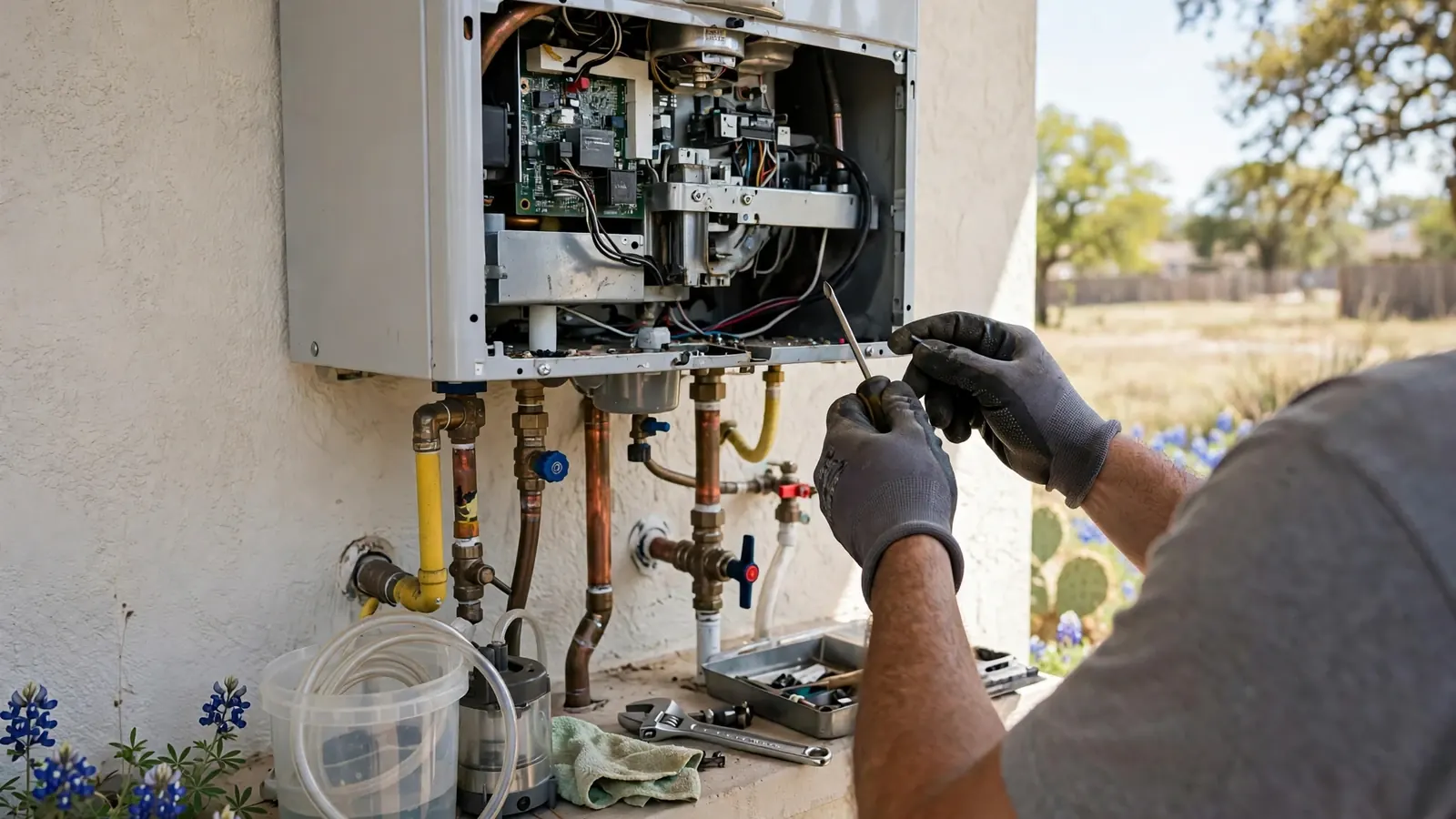
Where a tankless heater saves energy
A storage tank heats a large volume of water and keeps it hot all day and night. Heat slowly escapes through the tank walls, so the burner or element cycles on even when nobody is home. This is called standby loss.
Efficiency figures on a tankless unit come from the manufacturer's published ratings and the federal energy label, so read both before trusting a savings claim. Real savings depend on how much hot water your household draws, which is why the label is a comparison tool and not a promise.
A tankless unit has no stored water to keep warm. A flow sensor tells the heater to fire when you open a hot tap, and it shuts off when you close it. For a small household that uses hot water in short bursts, that cuts a real source of waste.
Where the savings shrink
The advantage is biggest in low use homes. In a busy household with back to back showers, laundry, and a dishwasher, a tankless unit is working much of the day, and the gap with a good tank narrows. Efficiency also varies by model, fuel, and how the unit is installed.
Check the label. The yellow energy guide and the manufacturer's rating tell you the efficiency of the specific model. Compare the same measure on both a tank and a tankless unit, and do not trust a general claim that one type always wins.
Tankless vs tank: honest trade-offs
| Factor | Tankless | Storage tank |
|---|---|---|
| Standby loss | None, since water is not stored | Present, since a full tank stays hot |
| Hot water supply | Continuous, limited by flow rate | Limited by tank size, then recovery time |
| Upfront and install work | Often higher, with gas line, vent, or electrical upgrades | Usually simpler, especially like for like |
| Upkeep | Needs periodic descaling and flushing | Needs a drain and an anode rod check |
| Lifespan | Often longer when maintained, check the maker's rating | Shorter on average |
| Flow at multiple fixtures | Can fall short if several run at once | Handles a burst of use until the tank runs low |
Flow rate is the limit you will feel
A tankless unit heats water as fast as its burner or elements can, which sets a maximum flow of hot water at the temperature you want. Run a shower, a dishwasher, and a washing machine together and a small unit may not keep up. Size the unit to your peak demand, not your average.
Incoming water temperature also matters. Colder incoming water means the heater has to work harder to reach the same output. Your plumber can size a unit to your fixtures and your household, and that sizing is worth more than any efficiency number on the box.
Gas lines, venting and electrical needs
A gas tankless heater often needs a larger gas line than a tank because it fires at a much higher rate. The vent is usually a sealed plastic or stainless system, and it must be installed to the maker's directions. An electric tankless unit needs a heavy dedicated circuit and may require a panel upgrade.
These items are why a tankless install is not a simple swap. They are also the main reason two quotes can look so different. A quote for a tankless water heater should itemize the gas line, vent, drain, and any electrical work.
Maintenance: the cost people forget
Mineral scale builds up inside a tankless heat exchanger. If it is not flushed, flow drops, the unit works harder, and error codes appear. Many makers call for periodic descaling, and the interval depends on your water.
Ask your water utility for its water quality report, and test your tap for scale. A household with scaling water should plan on regular flushing. A tankless unit that is never serviced loses much of the efficiency that made it attractive.
How to decide if tankless fits your home
- Count your peak useList what runs at the same time on a busy morning.
- Check your fuel and gas lineKnow whether you have gas or electric, and whether the line can support a tankless unit.
- Look at the vent routeFind a path to the outside for a sealed vent, or note that one has to be built.
- Read the efficiency labelCompare the rating of the exact tankless and tank models you are considering.
- Ask for an itemized quoteMake sure venting, gas, drain, and upkeep are listed.
Questions to ask before you buy
- What is the rated efficiency?Read it from the label, not from a sales pitch.
- Will it keep up with my peak demand?Ask the plumber to size it against your fixtures.
- What changes does my house need?Gas line, vent, drain, and electrical work should be named.
- How is it maintained?Ask how often to flush it and who does it.
- What if it fails?Ask about repair options and parts availability for the model.
When a tank is still the better choice
A tank can make more sense in a home with a tight budget, difficult venting, or a large household with heavy peak use. A tank is also simpler to repair in most cases, and a like for like swap avoids the gas and vent upgrades. If you are leaning that way, see water heater installation for the standard path.
Neither choice is wrong. The right pick depends on how you use hot water, what your house can support, and what you are willing to maintain.
Goose Creek notes: pick a licensed installer
The SC Residential Builders Commission, part of SC LLR, licenses residential plumbing contractors. Gas lines and sealed vents are safety work, so ask any installer for a licence number and confirm it at llr.sc.gov. The commission can be reached at 803-896-4696.
Goose Creek has grown from 3,656 people in 1970 to about 52,000, so you will find homes from many eras, each with different gas lines and vent routes. An older house may need more upgrades for a tankless unit than one built recently. Ask the installer to check your gas line capacity before quoting.
Permit rules vary, so ask the City of Goose Creek building inspection division whether a gas water heater install needs a permit and an inspection.
Homeowners in neighboring Hanahan weigh the same trade-offs, and the same label comparison applies there.
Not sure whether tankless fits your home? Call us and we will walk through the trade-offs for your layout.
☎ Call (855) 575-2890Questions Goose Creek homeowners ask
Get the licence number before you sign, then look it up on llr.sc.gov. The SC Residential Builders Commission licenses residential plumbing contractors, and you can reach it at 803-896-4696.
Do this before you sign anything, since gas lines and sealed vents are safety work.
Usually yes, because it does not keep a tank of water hot. How much it saves depends on your usage and the model. Heavy users see a smaller gap.
Check the efficiency label on both the tankless and the tank you are comparing, and do not rely on a general claim.
It gives continuous hot water, but only up to its maximum flow. Several fixtures running at once can exceed what a small unit can heat.
A plumber can size it to your peak demand so a busy morning does not leave you with lukewarm showers.
Yes. Scale builds up in the heat exchanger, so most makers call for periodic flushing. Skipping it lowers flow and efficiency and can trigger error codes.
Test your tap for scale and ask how often your model should be flushed.
Rarely. Tankless often needs a larger gas line, a different vent, or a heavier electrical circuit. A good quote lists each of those changes.
If those costs do not fit, a new tank may be the more sensible choice for your home.
Have a different question about tankless vs tank?
☎ Call (855) 575-2890