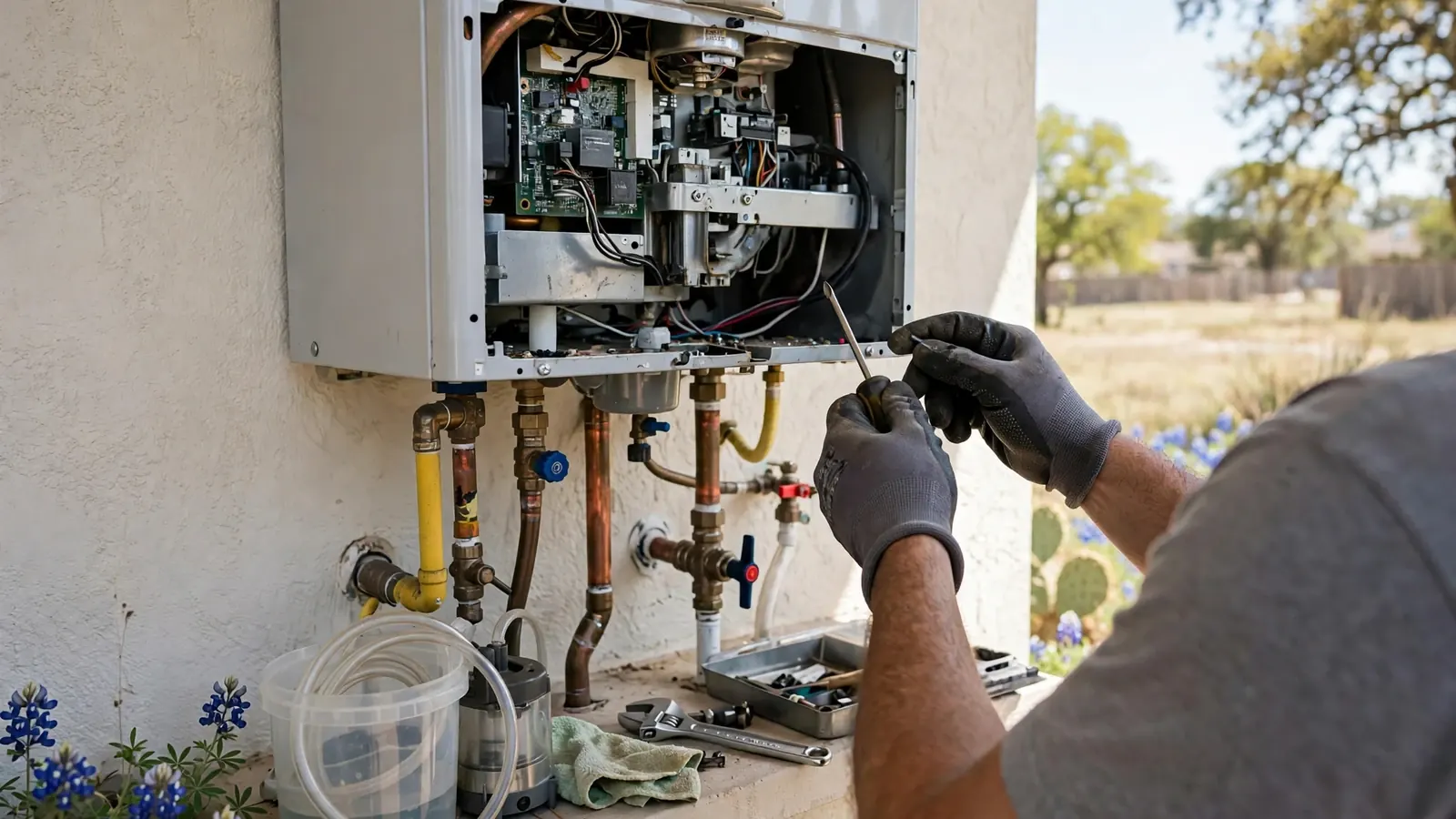
My tankless heater beeps, runs lukewarm or shows an error code
Callers describe the same pattern: the unit worked for years, then the water turned lukewarm, cut out mid-shower or began to beep with a code on the display. Another common story is a company that came out and said it only does replacement. That is not always the right answer for a unit with a heat exchanger that is still sound.
A tankless unit has to be installed to the manufacturer's instructions and to the plumbing codes adopted locally, including gas line sizing and venting for gas models. Those standards are why a tankless swap is rarely a same-size drop-in for an old tank.
Error codes differ by brand, so read the code in your manual and tell the dispatcher the brand, model and code. Common causes include scale on the heat exchanger, a clogged inlet screen, a bad flame or temperature sensor, poor exhaust venting and low gas supply. A burnt sensor wire is a known failure that a plumber can spot and replace.
Tankless symptoms and likely causes
- Lukewarm waterScale on the heat exchanger or a flow sensor that is not reading correctly.
- Water goes cold then hotOften a flow issue. The unit needs a minimum flow to fire, and low-flow fixtures can fall below it.
- Beeping and an error codeThe control board found a fault in ignition, exhaust, flow or temperature. The code points to the area.
- Reduced flowA blocked inlet filter or scale narrowing the water passages.
- Rumbling or kettle noiseScale buildup causing localized boiling inside the exchanger.
- Leak below the unitA loose fitting, failing valve or a cracked exchanger. Shut off water and gas and call.
- Unit not firing at allCheck gas, power and the vent. A blocked or disconnected vent shuts a gas unit down for safety.
Flush and descale: what the service involves
Minerals in water settle on the inside of a tankless heat exchanger. Over months, they narrow the passages and cause overheating, noise and error codes. A flush circulates a descaling solution through the unit with a small pump, then rinses it clean.
The job needs two service valves, also called isolation valves, on the hot and cold sides, so the pump can connect. Many units were installed without them, and adding them is part of the first service. The plumber also cleans the inlet screen, checks the venting and condensate drain on a condensing model, and confirms the gas pressure and sensor readings.
How a tankless service visit runs
- Read the unitBrand, model, age and error history are recorded, and the unit is run to see what it does.
- Isolate and connectWater and gas are shut off, the service valves are used or installed, and the flush pump is connected.
- Descale and rinseSolution circulates through the exchanger, then clean water rinses it out.
- Clean the filter and check partsThe inlet screen is cleaned. Sensors, wiring, venting and the condensate line are inspected.
- Test and adviseThe unit is fired, temperature and flow are tested, and you are told how often to repeat the flush.
Scale depends on your water. Ask the City of Goose Creek Water Division for the latest water quality report and test your tap, then share it with the plumber. Harder water usually calls for more frequent flushes. A softener or filter ahead of the heater also helps, and that is a conversation to have at the visit.
Tankless water heater installation
Going tankless is a bigger change than swapping one tank for another. A gas unit often needs a larger gas line to feed the burner, a special exhaust vent and a condensate drain if it is a condensing model. An electric unit may need a high-amp circuit and spare panel capacity, which not every house has.
Sizing matters. The plumber looks at how many fixtures you run at once and the temperature rise your water needs, then picks a unit with enough capacity. A unit that is too small gives lukewarm showers when the dishwasher starts. For the broader install checklist, see how planned installs are laid out.
Tank or tankless: how to decide
| Question | Tank points to | Tankless points to |
|---|---|---|
| Space | You have a closet or garage corner for a tank | You want wall-mounted equipment and floor space back |
| Gas or electric supply | Existing line and circuit are fine | You can upgrade the gas line or have panel capacity |
| Household demand | Hot water use is steady and modest | Back-to-back use or large tubs make endless supply useful |
| Water quality | You rarely service equipment | You will flush it on a schedule, especially if scale is a concern |
| Emergency timing | Failed tank needs a fast swap | You can plan the change, see tank replacement for emergencies |
Tankless acting up or on your list? Call and give us the brand, age and any error code.
☎ Call (855) 575-2890Tankless repair: parts that fail and when replacement makes sense
Many tankless faults are fixable: flow sensors, igniters, flame rods, thermistors, fans and control boards can be replaced. A heat exchanger that is cracked or badly scaled is the expensive failure. The age matters too. A unit approaching 18 or 20 years may be near the end of the road, while a younger unit is worth diagnosing.
If the answer is replacement, compare it with repairing a tank heater or a new tankless unit before you decide.
Tankless units can also hide a leak, since there is no tank to pool water. If a wet wall or a rising water bill shows up near the unit, leak detection is the next step.
Goose Creek notes: scale, age and neighboring towns
Goose Creek has added many homes since 2000, and tankless units are common in newer builds. Those units are now old enough for their first or second flush. If you bought a house with a tankless heater and no service history, plan a flush and ask for service valves.
The same advice applies in nearby Hanahan. Confirm your water provider from your bill, and ask them for the latest water quality information so the plumber can set a flush schedule.
What drives the cost of tankless service and installation
- Service or installA flush and inspection is a small job. A new install changes gas, venting, plumbing and sometimes electrical.
- Unit brand and ageParts availability and diagnostic steps vary by brand, and older units may need harder-to-find parts.
- Service valvesIf your unit has none, adding them is extra work, but it makes every future flush easier.
- Gas line and ventingA larger gas line or new vent runs can be the largest part of an install.
- Water conditionsHeavy scale lengthens the descale and may justify a softener or filter.
Descaling, flushing and an error code fix are maintenance, and a homeowner policy does not cover them. A unit that splits a heat exchanger and soaks the wall is a leak event, and the damage may count as sudden loss if it was unexpected. Slow drips behind the unit are a different story. Ask your insurer which one yours is.
Call for a clear price on service or a new tankless unit. Call (855) 575-2890.
Questions Goose Creek homeowners ask
Have the brand, model and exact code ready. Many codes point to scale, a clogged filter or a failed sensor, all of which are repairable. A plumber can diagnose the unit and tell you honestly whether the heat exchanger is still sound before anyone proposes a new one.
Most makers recommend flushing about once a year, and more often where scale builds fast. The Water Division posts the latest water quality report, so read it, test your tap and set the schedule with your plumber. Ask the plumber to record the flush date on the unit so the next one is not forgotten.
Possible causes include scale on the heat exchanger, a blocked inlet filter, low flow that falls below the unit's firing minimum, or a sensor fault. It can also happen when two fixtures compete for hot water at once. A flush, a filter clean and a flow check usually pinpoint the cause without guessing.
Often yes, if it still heats and has no leak. A flush, filter clean and sensor check can bring back performance in a unit that age. If the heat exchanger leaks or the unit has had repeated failures, replacement is the better call, and the plumber should explain why before you decide.
Frequently. Tankless burners draw much more gas at once than a tank heater does. The plumber measures the existing line and the distance to the meter, then tells you whether the line needs upsizing. That work is often the largest part of a new tankless install.
They are very useful. Isolation valves, also called service valves, let a plumber shut off the unit and connect a pump for flushing without cutting into pipes. If yours has none, ask for them at the first service so every later flush goes faster.
Yes, tankless service reaches beyond Goose Creek into Hanahan, Ladson and Moncks Corner, plus Summerville and North Charleston. Name your street when you call and dispatch checks that it falls inside the service area before sending a licensed plumber who works on gas tankless units, descaling and error codes.
Have a different question about tankless water heaters?
☎ Call (855) 575-2890