The parts list, from the floor up
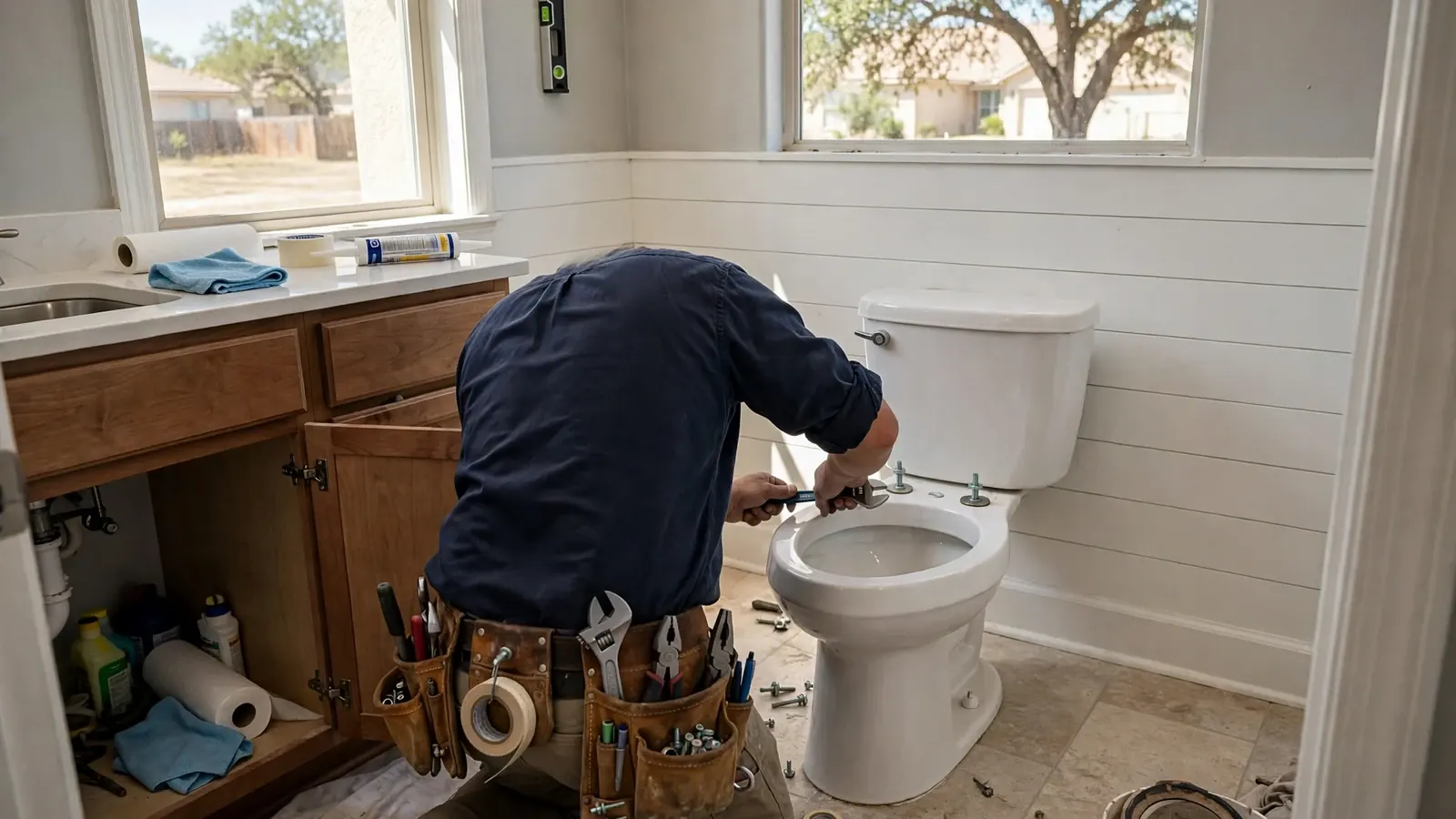
Think of a toilet install as a stack. The closet flange sits on the floor and connects to the drain. The wax ring seals the flange to the bowl. Closet bolts hold the bowl down. Above that, the supply line and shutoff valve feed the tank, and the fill valve and flapper control the water inside it.
Toilet fit depends on published dimensions such as the rough-in distance from the wall to the closet flange, and the installation should meet the plumbing codes adopted locally. Measure the rough-in before you buy, and follow the maker's instructions for the wax ring and bolts.
Toilet install parts and what each one does
| Part | Job | Check before you start |
|---|---|---|
| Closet flange | Anchors the toilet to the floor and connects to the drain pipe | Cracked, rusted, or sitting below the finished floor? |
| Wax ring (or wax free seal) | Seals the bowl outlet to the flange | Always use a new one, never reuse the old ring |
| Closet bolts and nuts | Hold the bowl to the flange, with plastic caps for finish | Corroded bolts that snap are common on older installs |
| Supply line | Carries water from the shutoff valve to the tank | Braided line long enough with no kinks or tight bends |
| Shutoff valve | Lets you stop water to this toilet only | Does it turn fully and stop the flow, or is it stuck? |
| Fill valve | Refills the tank after a flush | Sticking float, hissing, or constant refilling |
| Flapper | Seals the tank until you flush | Warped rubber that lets water leak into the bowl |
The closet flange: check it first
The flange is the ring on the floor that the toilet bolts to. If it is cracked, corroded, or loose, no wax ring will hold a seal for long. A flange should sit on top of the finished floor, or slightly above it, so the bowl outlet meets it squarely.
When the old toilet is out, press on the flange with a gloved hand. Movement means it needs fastening or replacement. If the flange sits below a new tile floor, a flange extender or spacer ring lifts it back to the right height. A flange that is cut, cracked, or broken away from the pipe is a repair job, not a quick swap.
Wax ring and closet bolts
The wax ring is a one time seal. Once a toilet has been set and rocked, the wax is compressed and should never be reused. A leak at the base, a loose bowl, or a faint sewer smell around the toilet usually points to a failed ring.
Closet bolts slide into slots in the flange and stick up through the bowl base. Stainless or brass bolts last longer than plain steel ones. Tighten the nuts a little at a time, alternating sides, because porcelain cracks when one side is cranked down hard.
Supply line and shutoff valve
A braided stainless supply line is the usual choice. It is flexible, easy to size, and less likely to burst than an old rigid or plastic line. Buy one long enough to reach without pulling taut, but not so long that it coils against the tank.
The shutoff valve, often called the angle stop, is the small valve on the wall or floor under the tank. Turn it fully closed before you do anything else. If it will not turn, drips from the stem, or does not stop the water, you have a second job: replacing the valve itself, which may mean shutting off water to the whole house first.
Safety and stop points
Shut off the water at the toilet's own valve, flush to empty the tank, and sponge out what remains. If the valve does not hold, close the main water shutoff for the house before you disconnect anything.
Do not force a stuck valve. A valve that snaps off in your hand floods the room. If the flange is broken, the floor is soft, or you see sewage when the toilet comes up, stop and call a licensed plumber.
Fill valve and flapper: the tank parts
Inside the tank, the fill valve refills the tank and shuts off at the right level. The flapper is the rubber seal at the bottom that lifts when you flush. A new toilet comes with both, but on a swap of only the tank parts they are the usual cause of a running toilet.
A fill valve that hisses, or a tank that keeps refilling every few minutes, is losing water past the flapper. Dye test it: add a few drops of food coloring to the tank, wait without flushing, and look for color in the bowl. If color appears, the flapper is leaking and should be replaced. Read more on toilet repair if the problem stays after new parts.
Installing a new toilet in the right order
- Shut off and emptyClose the supply valve, flush, and sponge out the tank and bowl.
- Disconnect and liftRemove the supply line, unscrew the closet bolt nuts, and lift the old toilet straight up. Plug the drain with a rag to block sewer gas.
- Clean and inspect the flangeScrape off old wax and check for cracks, rust, or movement.
- Set the new ring and boltsInstall new closet bolts, place the wax ring on the flange or the bowl outlet, and keep it centered.
- Lower the toilet straight downPress down evenly, thread on the nuts, and tighten a little at a time, alternating sides.
- Connect water and testAttach the supply line, open the valve slowly, flush several times, and check every joint for drips.
Replace these while the toilet is off
- The wax ringNever reuse it, even if the old toilet seemed fine.
- The supply lineA cheap part that prevents an expensive leak if it ages out.
- Closet boltsReplace corroded or bent ones, because a broken bolt means a loose bowl.
- The flapper and fill valveFresh tank parts make a new install behave as it should.
- The shutoff valveIf it weeps, sticks, or is more than a couple of decades old, change it now.
When a toilet install turns into a plumbing job
Some installs are a swap. Others uncover a rotted subfloor, a broken flange, a stuck valve, or a drain that backs up. If you plan to move the toilet or add a new bathroom, that is plumbing installation work, with new drain and vent lines, not a parts swap.
Ask a licensed plumber to take it from there when the floor is soft, the flange is not on solid footing, or the shutoff valve will not close. A clear price before the work starts is the right standard for any plumber you call.
Goose Creek notes: older bathrooms and what they hide
Goose Creek grew fast in the 1970s, with the Forest Lawn subdivision and Goose Creek High School under construction in 1969, and again rapidly after 2000. A home from the first growth era may still have its original shutoff valves and flange, which is a reason to test them before you plan a toilet swap.
If your home is from that era, assume the angle stop under the tank is original until you know otherwise. Turn it gently, and have a replacement valve and a plan for closing the main shutoff on hand. Newer homes from the post 2000 growth are less likely to have old valves, but a cracked flange can happen in any age of house.
Permit rules vary, so ask the City of Goose Creek building inspection division before you move or add a toilet.
Neighboring towns, same parts
The parts list is the same in nearby Hanahan and across Berkeley County. What differs is the age of the house, which tells you how likely a stiff valve or a corroded bolt is.
Stuck valve, cracked flange, or a toilet that will not sit level? Call us and we will talk it through.
☎ Call (855) 575-2890Questions Goose Creek homeowners ask
Not special parts, but expect older ones. Homes from that era may still have original shutoff valves and flanges, and those age badly. Test the valve before you plan the swap, and check the flange once the toilet is up.
A standard kit fits most modern toilets. The question is whether the old connections are still sound.
No. The wax is compressed the first time the toilet is set, and it will not reseal reliably after being lifted. A new ring costs little compared with a leak that rots a subfloor.
Wax free seals exist too. They are also single use in most cases, so follow the maker's directions.
Look for cracks, rust, a ring that moves under your hand, or a flange that sits below the finished floor. A toilet that rocks even after the bolts are tightened is another sign.
A flange spacer or repair ring can fix a low or loose one. A broken flange tied to a cracked pipe is a plumber's job.
Usually the flapper is not sealing, or the fill valve is set too high. Do the dye test: put food coloring in the tank and look for color in the bowl without flushing.
If the parts are new and it still runs, the flush valve seat may be worn, and the toilet may need repair or replacement.
Yes. Supply lines are cheap, and old ones can crack, kink, or corrode at the connection. Choose braided stainless, sized to reach the valve without stress.
Tighten by hand and a quarter turn with a wrench. Overtightening is a common cause of leaks.
Have a different question about toilet installation?
☎ Call (855) 575-2890