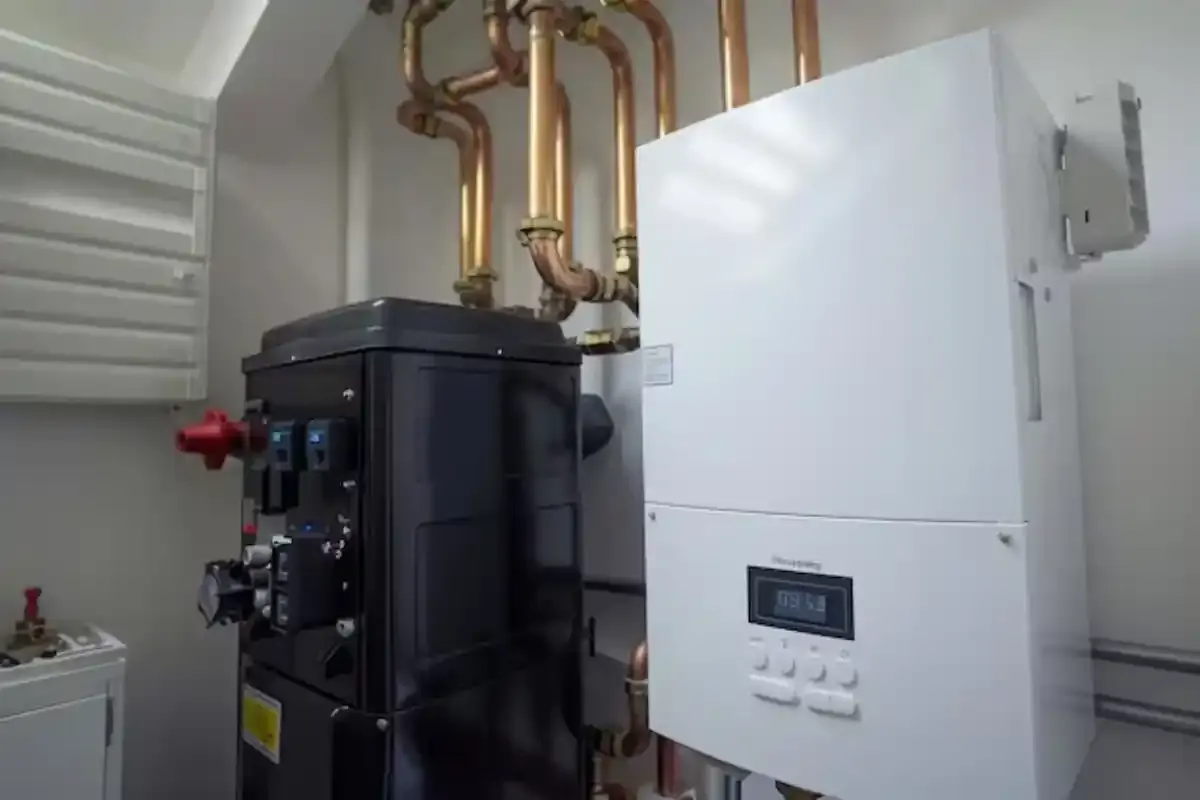
How an on demand heater works
Cold water enters a heat exchanger when a tap opens and the flow sensor trips. The burner lights, the exchanger heats the water to the set temperature, and hot water leaves the unit. When you close the tap, the burner stops, so nothing is being heated in the background.
Sizing a tankless unit follows the maker's flow and temperature rise tables, and installation must meet the plumbing codes adopted locally. Those published tables are the standard a plumber should show you when explaining why one model fits your house and another does not.
That is why people call it endless hot water, and it is true up to a limit. The unit can only heat so many gallons per minute. Run a shower, the dishwasher and a washing machine at once and a unit sized for one bathroom will give you lukewarm water.
Tank versus tankless at a glance
| Question | Storage tank | On demand tankless |
|---|---|---|
| How it heats | Keeps a full tank hot all day | Heats only when a tap is open |
| Limit | Runs out after the tank is used | Limited by gallons per minute |
| Space | Floor space for a large tank | Small wall-mounted unit |
| Gas and vent needs | Standard gas line and flue | Larger gas line and special vent |
| Maintenance | Flush sediment, check anode | Annual descale flush |
| Service life | Shorter, tank corrodes | Often longer, parts can be serviced |
What a tankless unit needs from your house
A gas tankless heater burns a lot of fuel in a short burst, so it usually needs a larger gas line than the tank it replaces. The vent is also different. Most units use a sealed, special vent material and a specific route, and a flue that served your old tank may not be allowed to serve the new unit.
Electric tankless units skip the vent but draw heavy current, so the panel and the wiring have to handle it. In either case the water side matters too: a unit sized for a hot tub or a large family needs enough incoming flow, and a pressure drop at the meter will show up as weak hot water.
Questions that decide if tankless fits
- How many fixtures run at once?Count showers, tubs, the dishwasher and laundry that overlap on a busy morning.
- Is your gas line big enough?A plumber measures the line length and pipe size to see if it can feed the burner.
- Where can the vent go?The vent must reach outside by a legal route, which can be hard in a closet or interior wall.
- Is there a drain nearby?Condensing units drain acidic condensate that needs a safe place to go.
- What is the water like?Scale builds on heat exchangers, so ask about a flush plan or a softener.
- Do you mind a short wait?Hot water can take a moment to arrive, and a brief cold slug can appear between uses.
Scale, flushing and error codes
Mineral scale is the leading reason tankless units fail early. As water heats, minerals harden inside the exchanger and narrow its passages, so the unit overheats or throws error codes. A yearly descale flush, using a pump and a mild acid solution, clears the buildup before it damages the unit.
Callers often tell us a previous company would only quote a replacement and refused to service an older unit. Service is usually possible. A flush, a filter clean and a check of the sensors fix many beeping, flickering or lukewarm complaints. If a unit shows a repeated error code, shut it down and write the code down before calling.
How a descale flush goes
- Isolate the unitShut off gas and power, then close the water valves on the service ports.
- Connect the pumpA hose runs from a bucket and pump through the cold port, and another returns from the hot port.
- Circulate the solutionThe mild acid runs through the heat exchanger and dissolves scale.
- Rinse and clean the filterFresh water flushes the lines, and the inlet screen is cleaned.
- Restart and testOpen the valves, restore power and gas, and check the temperature and the flame.
When tankless is a good fit and when it is not
Tankless suits a household that wants steady hot water without a large tank, owns the home long enough to enjoy the benefits, and has a layout that allows a clean vent route. It suits homes where a tank is eating floor space, and many people like having a wall unit instead of a bulky cylinder.
It suits fewer homes where gas capacity is tight, the vent route would need long runs or several turns, or hot water use is heavy and simultaneous. A plumber can look at the existing setup and tell you honestly. For a full look at models and installation, read about tankless water heater service, and if your old tank has simply worn out, a like-for-like tank replacement may be the simpler fix.
Goose Creek notes: scale and the age of the house
The City of Goose Creek Public Works, Water Division publishes an annual Consumer Confidence Report, the water quality report, on its water page. Ask the Water Division for the latest one, and test your tap at home, because scale decides how often a tankless unit needs flushing. We do not state a hardness number here because we have not verified one.
Goose Creek grew fast in the 1970s and again after 2000, so house ages vary a lot. Newer homes often have roomier gas runs and cleaner vent paths, while older ones may need a gas line upgrade or a new vent route before a tankless unit can be added. Ask for that survey before you buy any unit.
What to expect on the day
A tankless install takes longer than a tank swap because the gas line, vent and wall mount are new work. The plumber mounts the unit, runs the vent, upsizes gas if needed, adds isolation valves for future flushes, and sets the temperature. A relief valve and a drain or condensate line are part of a proper install.
Ask the plumber to show you the service valves and to write down the flush schedule. Some work needs a permit and an inspection, and rules vary, so ask the City of Goose Creek building inspection division. To verify the licence of anyone you hire, confirm the number with SC LLR at llr.sc.gov. Neighbors in Hanahan can read our Hanahan service page to see how dispatch works across town lines.
Wondering if a tankless unit fits your house? A licensed plumber can walk through your gas line size and vent route when you call.
☎ Call (855) 575-2890Questions Goose Creek homeowners ask
It gives hot water as long as the tap is open, but only up to its gallons per minute rating. Run too many fixtures together and the temperature drops.
Sizing the unit to your busiest morning is the real fix, not the marketing phrase.
The pipes between the unit and the tap still hold cold water from the last use, and some units need a moment to fire. A recirculation line or a small buffer tank can reduce the gap.
If the cold slug is new, a clogged filter or scaled exchanger may be the cause, so have the unit checked.
Plan on a flush at least once a year, and more often if your water leaves white crust on fixtures. Scale slowly chokes the heat exchanger and raises the chance of overheating and error codes.
Ask the plumber to install isolation valves so future flushes are quicker.
Sometimes, but often not. The burner draws more fuel in a short burst, so a longer or smaller gas line may need upsizing. The vent also tends to differ from a tank's flue.
A plumber can measure the run and the pipe size before you commit to any unit.
Write down the code, turn the unit off, and check that the vent and filter are clear. Many codes point to scale, a blocked vent or a flame sensor problem.
Do not keep restarting it. Call a licensed plumber with the code in hand.
It can be, but older houses often need a new vent route, a bigger gas line, or both. The wall space also needs to be free and sound.
A site visit tells you what the house will allow before you pick a model.
Have a different question about water heater guide?
☎ Call (855) 575-2890