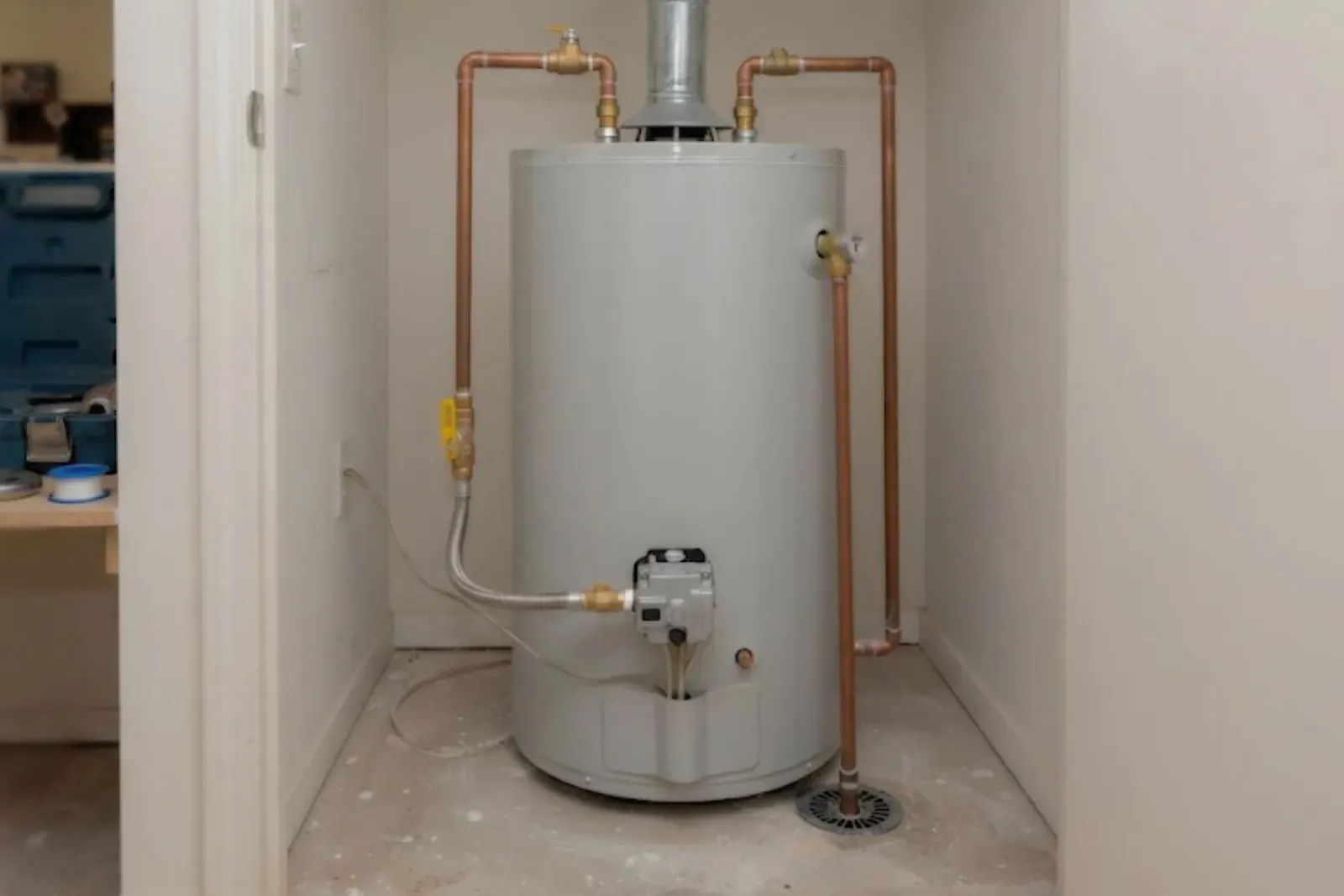
The short answer: six lines decide the total
Two homes on the same street can get very different quotes for the same 50 gallon tank. One has the heater in a garage corner with a fresh gas line and a clear vent. The other has it in a tight closet with a rusted flue and a drain pan nobody has looked at in years. The equipment is identical, the labor is not.
Cost drivers like venting, relief valve discharge and expansion control come from the plumbing codes adopted locally (built on the UPC and IPC model codes) and the maker's instructions, so they are not optional extras. If a quote leaves them out, ask why before comparing it with a quote that includes them.
That is why a phone ballpark is only a starting point. A plumber who asks what fuel you have, where the heater sits, and how old the vent is will give you a better range than one who answers with a single figure in ten seconds.
Tank size and capacity
A bigger tank costs more to buy and weighs more to move. Going from a 40 gallon to an 80 gallon unit can also change the footprint, the height, and the clearance to the ceiling or the vent. If your household has grown or shrunk since the last install, this is the moment to resize.
Do not size by habit. Count the people, the number of showers that run back to back in the morning, and whether a soaking tub or a dishwasher shares the same heater. A unit that is too small runs out mid shower. A unit that is too large keeps more water hot all day and costs more to run.
If your goal is endless hot water instead of a bigger tank, read about the tankless option first, because it changes the gas line, the vent, and the electrical needs in ways a tank swap does not.
Fuel type: gas, electric, or a switch
Replacing like for like is the simplest path. A gas tank swapped for a gas tank reuses the gas line, the shutoff, and usually the vent. An electric unit swapped for an electric unit reuses the dedicated circuit, provided the breaker and wiring are in good shape.
Changing fuel is where quotes jump. Going from electric to gas means a new gas line, a vent through the roof or wall, and a combustion air plan. Going from gas to electric means a new circuit and often a panel check. Neither change is wrong, but each adds labor lines that a like for like swap does not have.
How to read each line of a replacement quote
| Quote line | What it should say | Question to ask |
|---|---|---|
| Water heater unit | Capacity, fuel, model, and efficiency label | Is this the same size as my current tank, and why or why not? |
| Venting | Reuse, re-line, or replace, with the reason | Was the old flue inspected before it was reused? |
| Code items | Expansion tank, relief valve and drain line, seismic or strap items, gas shutoff | Which of these are required for my install and which are optional? |
| Connections | New flex lines, shutoff valves, dielectric fittings | Are the old supply lines being replaced or reused? |
| Haul-away | Removal and disposal of the old unit | Is disposal included, or do I handle it myself? |
| Permit | Whether a permit is pulled and who pulls it | Who schedules any inspection the city requires? |
Venting changes
A gas water heater exhausts combustion gases through a flue. If the old flue is corroded, undersized, or runs at the wrong pitch, a new heater cannot simply plug into it. Re-lining or replacing the vent adds parts and labor, and it is a safety item, not an upgrade to skip.
Newer high efficiency gas units may vent through plastic pipe out a side wall, which means drilling through framing and sealing the opening. Power vent models need an outlet nearby. Ask the plumber to tell you which vent type your new unit uses and why that type was chosen for your layout.
Code upgrades that show up on the quote
Plumbing codes adopted locally can require items an older install never had. Common ones are an expansion tank on a closed system, a temperature and pressure relief valve with a drain line piped to a safe location, a drip pan under a heater in a finished space, and a proper gas shutoff within reach.
These lines can look like padding to a homeowner, but they exist because a tank holds a lot of hot water under pressure. Ask for each code item by name and ask why it applies. A plumber who cannot explain a line should not be charging for it.
Permit rules vary, so ask the City of Goose Creek building inspection division whether your replacement needs a permit and an inspection. A licensed plumber should know the answer or tell you plainly that they will check.
Access and where the heater sits
Labor is mostly about reaching the heater and getting the old one out. Garage and utility room installs are straightforward. Attic heaters need a ladder, a platform, and extra care with the drain pan. Closets with tight doors may need the unit tipped or cut out in pieces.
Tell the plumber about stairs, narrow doors, finished flooring, and whether the heater sits above living space. A leak from an attic unit damages ceilings, so many installers add a pan and a drain line there. That is a cost with a real reason behind it.
Haul-away and cleanup
An old 50 gallon tank weighs a lot even when drained, and it is full of sediment. Disposal is a real task, and some quotes include it while others leave it to you. Ask which one you are getting before you compare two numbers that may not cover the same work.
Also ask what happens to the old tank. It should leave your property, not sit behind the garage for months.
Checklist before you accept any water heater quote
- Size matches your useThe quote states capacity and explains why it is the same as, or different from, your current tank.
- Fuel and venting are namedYou know whether the old flue is reused, re-lined, or replaced, and why.
- Code items are listedExpansion tank, relief valve and drain line, gas shutoff, and any pan are itemized instead of buried in a lump sum.
- Haul-away is statedThe quote says yes or no to removal of the old unit.
- Permit is addressedIt says whether a permit is needed and who handles it.
- Licence is verifiableYou have the plumber's licence number and have confirmed it with SC LLR.
Repair or replace, and why it changes the cost
A thermostat, element, or gas valve can often be fixed for far less than a new unit. A leak from the tank itself cannot, because the steel liner has failed. If your heater is old and leaking at the bottom, the question is not repair or replace, it is how soon.
If the problem is a smaller part, read about water heater repair before you spend on a full swap. If the tank is done, the replacement process is the next step, and the six drivers above apply.
What changes the price of a replacement heater
- Tank capacity and modelLarger tanks and higher efficiency models cost more to buy and to move into place.
- Fuel type and any conversionLike for like reuses existing lines. Changing fuel adds gas piping or electrical work.
- Venting conditionA corroded or undersized flue must be repaired or replaced before a gas unit can run safely.
- Code and safety itemsExpansion tank, relief valve drain, pan, and gas shutoff are added where they apply.
- Access and haul-awayAttic, closet, and crawlspace installs take longer, and disposal of the old unit is either included or not.
Homeowner policies usually cover sudden accidental water damage, such as a tank that bursts and floods a room, but not wear, age, or a slow leak that went unnoticed. The policy decides, so call your insurer before you assume either way.
Call us with your heater's fuel, size, and location, and we will tell you which of these drivers apply to your house. Call (855) 575-2890.
Goose Creek notes: check your water before you pick a heater
Before you pick a heater, read the city's yearly Consumer Confidence Report on its water page. Ask the Water Division for the latest copy, because it is the right place to read about the water your heater actually holds. We do not quote a hardness number here, since none has been verified from a primary source.
The practical step is simple. Test your own tap, look at the inside of an old tank or a shower head for scale, and tell the installer what you see. Heavy buildup in the old unit is a reason to ask about sediment drain valves and a flush schedule on the new one.
One more local tie-back: SC LLR licenses residential plumbing contractors. Ask for the licence number and confirm it at llr.sc.gov before you sign. Its phone line is 803-896-4696 if you would rather check by voice.
A word on neighboring towns
If you are shopping for a plumber from nearby, note that quotes in neighboring Hanahan follow the same logic. On either side of the line, ask for the same six lines in writing so you can compare.
Ready to get a clear price for your heater? Call us and describe where it sits and what fuel it uses.
☎ Call (855) 575-2890Questions Goose Creek homeowners ask
Ask the City of Goose Creek Public Works Water Division, which publishes an annual Consumer Confidence Report on its water page. If you are unsure whether the city or another provider serves your address, check your latest water bill.
Test your tap and look for scale on fixtures. That tells you more about your own house than a citywide report.
The tank is only one line. Venting work, code items such as an expansion tank, haul-away, and access all change the labor. A low quote that leaves out the vent or the disposal is not actually lower.
Ask each plumber for the same six lines in writing and compare them side by side.
Yes. A fuel change adds work that a like for like swap does not. Going to electric usually means a new circuit and a panel check. Going to gas means gas piping, a vent, and combustion air.
Either can make sense for your house, but the quote should show each added item separately.
Whether a heater swap needs a permit can differ from house to house, so the building inspection division is the place to ask. A licensed plumber should either know the answer or check with the city before work starts.
Ask who pulls the permit and who schedules any inspection, so nothing is left to chance.
Usually it covers sudden accidental water damage, such as a tank that bursts and floods a room. It does not usually cover the heater itself when it wears out, or damage from a slow leak.
Your policy decides. Call your insurer and ask before you assume anything.
You should. A good quote lists the unit, venting, code items, connections, haul-away, and permit status as separate lines. Call us to talk through your situation, and we will explain each line and give you a clear price before any work starts. Ask about venting and code items first, since those lines vary most from house to house.
Have a different question about water heater costs?
☎ Call (855) 575-2890